• Home
  • About
    ▼
    • About Laurie Schmitt
    • Honors and Awards
    • Inspirational Quotes
  • Divorce
    ▼
    • Uncontested Divorce
    • Collaborative Divorce
    • Mediation
    • Spousal Support
    • Spousal Support Modification
    • Annulments
    • Separate Maintenance
    • Alternative Divorce Options
  • Family Law
    ▼
    • Limited Scope Services
    • Child Custody
    • Change of Domicile
    • Post-Judgement Modification
    • Enforcement of Court Orders
    • Child Support
  • Paternity
    ▼
    • Affidavit of Parentage
    • The Michigan Paternity Act
    • How Does A Paternity Case Work
  • Blog
  • Contact
  • Skip to primary navigation
  • Skip to main content
  • Skip to primary sidebar
  • Skip to footer

Laurie Schmitt Family Law

W. Michigan family law specializing in Collaborative Divorce

  • Facebook
  • LinkedIn
  • Twitter

616.608.4634

  • Home
  • About
    • About Laurie Schmitt
    • Honors and Awards
    • Inspirational Quotes
  • Divorce
    • Uncontested Divorce
    • Collaborative Divorce
    • Mediation
    • Spousal Support
    • Spousal Support Modification
    • Annulments
    • Separate Maintenance
    • Alternative Divorce Options
  • Family Law
    • Limited Scope Services
    • Child Custody
    • Change of Domicile
    • Post-Judgement Modification
    • Enforcement of Court Orders
    • Child Support
  • Paternity
    • Affidavit of Parentage
    • The Michigan Paternity Act
    • How Does A Paternity Case Work
  • Blog
  • Contact

Archives for August 2022

Common Sense Divorce Rules

August 30, 2022 By Laurie Schmitt

The following are common sense rules for couples in the midst of a divorce. 

THE “DO’S”

  • Do start making a list of your debts (and their balances as of the filing date of the divorce).
  • Do start making a list of your retirement accounts (and their balances as of the filing date of the divorce).
  • Do maintain the household expenses – “status quo”.
  • Do start working with your spouse to discuss division of personal property.  After all, who wants to spend money on an attorney to help you divide your “stuff”.
  • Do start having discussions with your spouse about finances.
  • Do start having discussions with your spouse about the disposition of the marital home.  Do either of you want to keep the marital home after the divorce or do both of you agree to sell it. 
  • Do discuss with your spouse how and when you will tell the children that you intend to file for a divorce.
  • Do seek counseling for yourself or the children, if necessary.
  • Do remain or get active with your children and their education.
  • Do prioritize your children and their emotional needs during this difficult time.
  • Do start thinking about your budget post-divorce.
  • Do make your discussions with your spouse productive. 

THE DO NOT’S” 

Do’s and Don’ts Divorce

And yes, this list tends to be much longer!

  • Do not hide, give away, or destroy personal property.
  • Do not give away pets.
  • Do not remove money or empty out your retirement accounts.
  • Do not cancel health, auto, or life insurance policies (for your spouse or the children).
  • Do not cancel utilities associated with the marital home.
  • Do not cancel your spouse’s cell phone service.
  • Do not take out any new loans (such as personal loans, or home equity loans).
  • Do not cash out life insurance policies.
  • Do not sell real property (without an agreement between the parties).
  • Do not sell vehicles (without an agreement between the parties).
  • Do not run up credit cards.
  • Do not make large purchases such as a house or vehicle.
  • Do not change your children’s school (without an agreement between the parties).
  • Do not stalk or harass your spouse (this even means excessive texts, calls, and emails).
  • Do not discuss the divorce in front of your children.
  • Do not ask your children who they want to live with (as adults and judges make this decision, not children).
  • Do not alienate your children from your spouse.
  • Do not ask your children to take sides.
  • Do not discuss your divorce on social media.

AN ATTORNEY WHO UNDERSTANDS YOUR CIRCUMSTANCES

At Schmitt Law, PLLC, our clients benefit from years of experience. We treat every client as an individual, taking the time to understand your unique situation, so as to best advise you on the steps you should take. Whatever stage your life is at, you can trust Schmitt Law, PLLC to guide you through the legal process with expertise and compassion, because we understand that family comes first. Contact Schmitt Law, PLLC today by completing our online contact form, or calling us at (616) 608-4634 to schedule a consultation.

Filed Under: Collaborative Divorce, Divorce

The Biggest Concern When Divorcing Without Minor Children: It’s About The Money

August 26, 2022 By Laurie Schmitt

Divorcing when there are no minor children certainly should be easier than couples who must address custody, parenting time, and child support. However, even when there are no issues regarding children to discuss, couples still must address the touchy subject of money. And discussions surrounding money are never easy. 

The three biggest concerns that couples with no children must address are spousal support, division of assets, and separate property. And addressing these concerns can lead to challenges for couples. 

Below are the three biggest financial concerns that couple must address when divorcing without children:

1. SPOUSAL SUPPORT: 

Divorce and Money

Many factors are considered by the court as relevant in determining whether spousal support should be awarded. If the parties are unable to reach an agreement on the amount and length of time spousal support will be paid, the issue must be decided by the judge. If the issue of spousal support must be adjudicated, the court will look to the following factors is deciding on amount and duration of a spousal support award: (1) the past relations and conduct of the parties, (2) the length of the marriage, (3) the ability of the parties to work, (4) the source and amount of property awarded to the parties, (5) the age of the parties, (6) the ability of the parties to work, (7) the present situation of the parties, (8) the needs of the parties, (9) the prior standard of living of the parties, (10) general principles of equity.

2. DIVISION OF ASSETS:

Think of it this way, everything is considered a marital asset until it’s proven otherwise.  This includes all real property, personal property, vehicles, recreational vehicles, boats, retirement accounts, 401K’s, IRA’s, stocks, bonds, and the list goes on.  If you own it, it’s a marital asset until one party shows the court otherwise. And the basic Rule: the marital estate is divided between the parties (fairly, not necessarily equally).

3. SEPARATE PROPERTY ISSUES:

Courts distinguish between marital property and separate property, with separate property being property acquired before the parties married, and marital property being property acquired during the marriage. Michigan has adopted a doctrine called the doctrine of non-invasion of separate property. As a general rule, separate property (before marriage) is awarded to the party who owned the property prior to marriage, unless the other party substantially contributed to its acquisition or appreciation or the estate is otherwise insufficient. (For example, if you purchased your home before marriage, the increase in value of the property during the marriage will often be considered marital.)

However, Michigan law allows the trial court to invade the separate assets of a party under two distinct exceptions: First, “if the estate and effects awarded to either party are insufficient for the suitable support and maintenance of either party” and second, “if it appears from the evidence in the case that the party contributed to the acquisition, improvement, or accumulation of the property.” Even if separate property of one party is awarded to the other spouse, the ultimate property division is to be fair and equitable under all of the circumstances of the case.

CONTACT AN EXPERIENCED DIVORCE ATTORNEY IN GRAND RAPIDS, MI

Divorce can be emotional and messy, and it’s natural for anyone going through a divorce to want to protect their financial interests. Maintaining an objective view of the situation can be difficult when you are struggling with complex emotional issues and personal tensions in your divorce. As an experienced Michigan divorce lawyer, Schmitt Law, PLLC can help you maintain control over your property in divorce, and provide detailed guidance and support throughout every step of the process. The right attorney can increase the likelihood of you securing a favorable outcome to property division in your divorce.

Laurie Schmitt of Schmitt Law, PLLC has years of experience representing clients in a wide range of difficult divorce cases. We understand the financial concerns our clients often have regarding their property ownership rights and the doubts they often experience when it comes to property division in divorce. If you are seeking a divorce, contact us today to schedule a consultation. Contact Schmitt Law, PLLC online or by calling (616) 608-4634 for a consultation today.  

Filed Under: Divorce Tagged With: Concerns, Cost

Key Questions To Ask Your Divorce Lawyer

August 23, 2022 By Laurie Schmitt

CAN MY SPOUSE PREVENT ME FROM GETTING A DIVORCE?

  • No. If you have filed for divorce, your spouse cannot stop the divorce from being finalized. The court will move the case along, with or without his permission or participation.

WILL I BE RESPONSIBLE FOR MY SPOUSE’S STUDENT LOAN DEBT?

Key questions to ask lawyer
  • Not generally. If the spouse acquired the student loan debt before the marriage, then typically the debt remains the sole responsibility of that spouse. Note, there can be narrow exceptions to this rule. Contact Schmitt Law, PLLC to obtain further information about student loan debt.

IS MY SPOUSE ENTITLED TO A PORTION OF MY RETIREMENT ACCOUNT?

  • Yes, if the retirement account was acquired during the marriage. If the retirement account was acquired before marriage, then it may remain separate property of that spouse.

WILL I BE RESPONSIBLE FOR MY SPOUSE’S MEDICAL DEBT?

  • Yes. Medical debt acquired during the marriage is considered marital debt, to be divided equally between the parties.

WILL MY SPOUSE BE RESPONSIBLE FOR MY ATTORNEY’S FEES?

  • Do not count on an attorney’s fee award. You may always file a motion to request assistance with payment of your attorney’s fees. However, there is no guarantee that the judge will grant such a request. The answer to this depends on your specific facts and circumstances. Contact Schmitt Law, PLLC to obtain more information about requesting your attorney’s fees to be paid by your spouse.

ARE MEN EVER GRANTED SPOUSAL SUPPORT?

  • Yes. The court does not have gender bias when it comes to the determination of payment of spousal support. The court reviews specific factors to determine if the payment of spousal support is appropriate – and awards spousal support when it is appropriate. These awards are not based on gender.      

ARE MEN EVER GRANTED CUSTODY?

  • Yes. Men can be granted custody of the minor children. The court reviews the 12 best interest factors when making a determination about custody. Gender does not necessarily play a role in the court’s final decision on custody.

Note, the contents provided above are for general information purposes only, and should not be construed as legal advice on any specific facts or circumstances. As family law is complex, answers to your specific and unique situation may vary greatly from the general answers provided in this blog. 

EXPERIENCED DIVORCE ATTORNEY

We understand that filing for divorce can be an emotional and confusing experience.  That is why we are committed to providing personalized service to each client we represent, and will be with you through this difficult journey. We are prepared to guide you in all aspects of your case.

To discuss your circumstances and legal options, contact Schmitt Law, PLLC online or call (616) 608-4634 to schedule a consultation. 

Filed Under: Divorce, Mediation Tagged With: Divorce Lawyer, Spousal Support

What Is An Ex Parte Motion With Regard To Children?

August 19, 2022 By Laurie Schmitt

EX PARTE DEFINED

An ex parte motion is a motion filed with the court and signed by a judge before the other party is given notice of the motion, and before they are given an opportunity to be heard in front of the court.

WHAT YOU WILL BE REQUIRED TO PROVE AN EX PARTE MOTION

You must clearly show in your ex parte motion that the minor child will suffer irreparable injury, loss or damage will result from the delay required to effect notice.

CIRCUMSTANCES WHEN AN EX PARTE MOTION MAY BE APPROPRIATE

Some of the reasons an individual would file an ex parte motion in a family law case are as follows:

  • A parent has taken the children and is hiding them
  • A parent refuses to return the children per the terms of the custody/parenting time order
  • A parent has moved the children to another state without permission of the other parent or without obtaining a court order from the judge
  • A parent has recently become homeless and has no safe place to visit with the children

WHY EX PARTE MOTIONS FAIL

Ex Parte Motion and Children

Judges vary greatly as to what they deem an emergency meriting the issuance of an ex parte order. With the same facts presented, some judges will issue an ex parte order, while others will not. Judges require compelling reasons to grant an ex parte order, as a request for an ex parte order is done without giving the other person notice of the motion, and done without a hearing. 

Common reasons why ex parte motions fail:

  • The judge believes that the crisis has passed.
  • The moving party failed to provide enough facts in their ex parte motion to clearly define the emergency.
  • The circumstances do not meet the test of “the minor child will suffer irreparable injury, loss or damage will result from the delay required to effect notice”.

PARTIES MAY OBJECT TO AN EX PARTE ORDER

If you have been served with an ex parte order, you have the right to object. You may

file a written objection to an ex parte order or file a motion to modify or rescind the ex parte order. You must file the written objection or motion with the clerk of the court within 14 days after you were served with the ex parte order.

IF YOU DO NOT OBJECT TO THE EX PARTE ORDER

The ex parte order will automatically become a temporary order if you do not file a written objection or motion to modify or rescind the ex parte order and a request for a hearing. Even if an objection is filed, the ex parte order will remain in effect and must be obeyed unless changed by a later court order. MCR 3.207(B).

WE CAN HELP!

We know your legal issues are unique and special. Call us, we will listen. To schedule a consultation or learn more about our services, contact Schmitt Law, PLLC online or call (616) 608-4634.

Filed Under: Other Family Law Issues Tagged With: Children, Ex Parte Motion

Your Choices For Divorce Resolution – The Checklist

August 15, 2022 By Laurie Schmitt

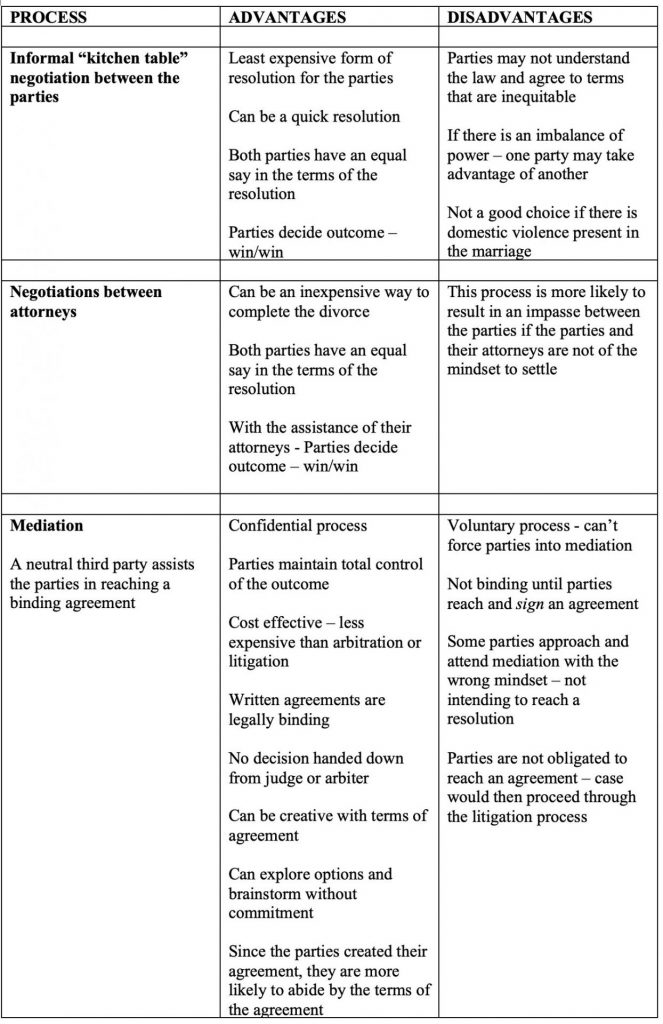
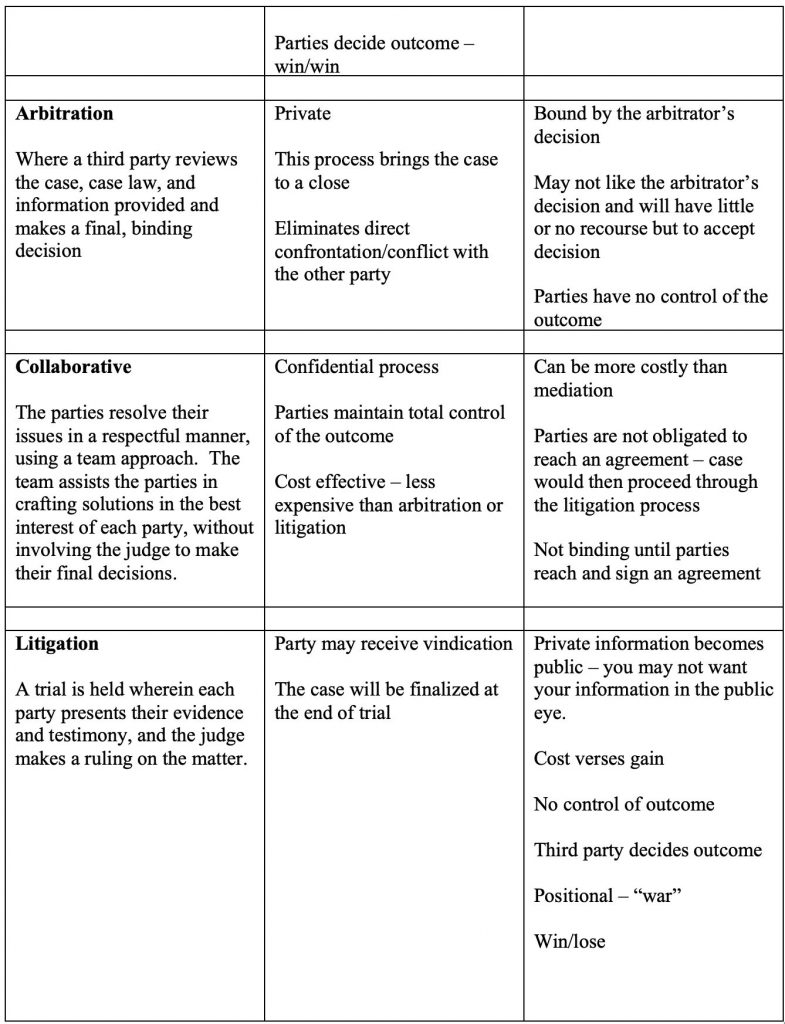
There are many ways you can complete your divorce. Each divorce resolution option has it’s good and bad. With that said, each divorce resolution process may not be the best choice in all divorce cases. Selecting your divorce resolution process to complete your divorce can affect your emotions, your pocketbook, and the outcome. Select wisely!

The following is a chart outlining each divorce resolution process and their advantages and disadvantages:

EXPERIENCED DIVORCE ATTORNEY

If you want to learn more about what divorce resolution process may be right for you and your family, schedule your consultation today with Laurie Schmitt of Schmitt Law, PLLC.

We look forward to speaking to you and being your advocate during this crucial time in re-framing your life. Contact Schmitt Law, PLLC online or call (616) 608-4634 to arrange a consultation.

Filed Under: Divorce Tagged With: Choices, Process, Resolution

Violating The Terms of Your Custody Order

August 12, 2022 By Laurie Schmitt

IT’S NOT VOLUNTARY TO FOLLOW THE TERMS OF A CUSTODY ORDER

No parent has the right to violate the term of their custody order. If you believe the terms of your custody order is no longer in the best interest of your child, then take action and ask the court to change the custody order. Ask the judge for relief before you make a unilateral decision to violate the terms of your custody order. It’s much easier to ask permission from the court then to beg for forgiveness of the court.

Just remember, judges do not look favorably at parents who take matters into their own hands and take actions that are contrary to their court orders. So, before you make decisions that conflict with the terms of your custody order, consider the consequences. 

WHAT IS CONSIDERED A VIOLATION OF A CUSTODY ORDER?

Child Custody Terms
  • Refusing to exchange the child on time.
  • Refusing the other parent their court awarded parenting time.
  • Refusing to return the child after your parenting time has ended.
  • Refusing to follow the rules of joint legal custody. If you share joint legal custody you must consult with the other parent and attempt to agree before major decisions are made affecting the minor child’s education, enrichment activities, camp, travel, and medical problems.
  • Taking action to prohibit the other parent from accessing school, psychological, dental, and medical records.
  • Any other action that contradicts specific terms of your custody order.

WHAT CAN HAPPEN TO ME IF I VIOLATE A CUSTODY ORDER

If you violate your custody order and are found in contempt of court, you would be subject to sanctions such as:

  • Being ordered to pay a fine to the court
  • Being ordered to give the other parent makeup parenting time
  • Jail

It the worst violations, or repeated violations, the court could consider a change in custody and/or parenting time.

WHAT IF THERE IS AN EMERGENCY THAT REQUIRES ME TO VIOLATE THE TERMS OF MY CUSTODY ORDER?

The court has a process to address true emergencies. They are called ex parte motions.

If an emergency has arisen, and you believe an immediate change in parenting time is required, then file an ex parte motion and request the judge for the specific relief that will temporarily protect the children. Filing an ex parte motion can be achieved quickly, so there is no need to violate your custody order. Once again, ask the court for relief before you violate the terms of your custody order, not after.

CUSTODY ATTORNEY

At Schmitt Law, PLLC, we help parents work together to create a parenting plan that is in the best interests of your children. Through mediation, collaboration, or litigation, if necessary, our knowledgeable Michigan family law attorney will be your advocate and help you through this difficult time. To schedule a consultation or learn more about our services, contact us online or call (616) 608-4634.

Filed Under: Issues Concerning Children Tagged With: Custody, Terms, Violating

A Successful Divorce Mediation

August 9, 2022 By Laurie Schmitt

Mediation is set in your divorce case. How do you set yourself up to have a successful mediation? Here are the top tips to ensure you make the most of your time and money at mediation:

  • COMPROMISE AND CONCESSIONS ARE NECESSARY.

If neither you nor your spouse are willing to move from your point of view, your case will inevitably end up in the hands of the judge. Remember, mediation is a voluntary process wherein you and your spouse maintain total control of the outcome of your divorce. You own the process and own the outcome.

  • BE PREPARED. 
Divorce Mediation

Have your financial documents with you at mediation. Remember, it’s impossible to resolve financial issues without written documentation. Be prepared to show the mediator and your spouse through statements. Don’t expect them to believe it just because you say so. 

  • BE REALISTIC WITH YOUR EXPECTATIONS.

Set your goals appropriately. Remember, there is never a time that just one-party walks out of mediation with everything they set out to get. 

  • BE COOPERATIVE, NOT COMPETITIVE. 

Look for your common shared interests. Look for the win/win.

  • BE OPEN MINDED. 

Be prepared to listen to your spouse and consider their point of view. An agreement today can result in improved capacity co-parent in the future. Once again, a win/win.

  • DON’T PLAY THE BLAME GAME. 

The mediator doesn’t want or need to know the details of why you are seeking a divorce.  The mediator is a neutral third party assisting you in getting to a resolution. The “what happened during our marriage” conversation is not necessary.

  • GET YOUR HEAD IN THE GAME.

Enter into mediation with the mindset you are here to fully engage in the process, to get resolution in your divorce, and to walk out of mediation starting your new life.

  • WATCH YOUR WORDS AND YOUR TONE.

If your true goal is to reach settlement, then be careful what you say and how you say it. This is not marriage counseling, a trial, or the time to hash out your differences.

Mediation empowers couples. Set aside your anger and frustration, your need to win, and your need to blame. If you are able to do so, you will walk out of mediation with a durable agreement that satisfies both you and your spouse. And, you will have maintained total control of the outcome of your divorce. Parties who reach their own agreement are much more satisfied than parties who hand the power over to the judge.

  • DIVORCE AGREEMENTS BASED ON FAIRNESS

When attorneys listen to their clients and work together to create a fair settlement, contested divorces can be effectively settled through negotiations and alternative dispute methods. When possible, Schmitt Law, PLLC focuses on resolving divorce and child custody matters through mediation or collaborative divorce methods. These alternative dispute methods allow you to have complete control over the outcome of your future.

Contact Schmitt Law, PLLC today by completing our online contact form, or calling us at (616) 608-4634 to schedule a consultation.

Filed Under: Divorce, Mediation

What is a Pre-Filing Strategy Meeting?

August 5, 2022 By Laurie Schmitt

After the consultation, many clients contact Schmitt Law, PLLC for a pre-filing strategy meeting. What is a pre-filing strategy meeting and how can it help you?

WHAT IS A PRE-FILING STRATEGY MEETING?

A pre-filing strategy meeting is more in depth than an initial consultation. Consultations are broader in nature, whereas pre-filing strategy meetings focus on specifics…what you should do to prepare for your divorce filing.

WHAT DO WE TALK ABOUT IN A PRE-FILING STRATEGY MEETING?

Prefiling Strategy Meeting

These conversations are designed to meet the individual needs of each client. We may discuss financial issues, how to protect your assets, and other topics of concern to the client.

Most of all, we talk about what matters most to you – what your greatest concerns are.

HOW CAN A PRE-FILING STRATEGY MEETING HELP YOU?

In a pre-filing strategy meeting, we will outline what you should be doing before the divorce filing, and how you can avoid pre-filing mistakes that may harm you later in your divorce. It’s better to start your divorce on the correct foot, than to pay the price in front of judge for making a bad decision before filing.

CAN I/SHOULD I?

Clients have many questions about what they can or should do before filing for a divorce. Many of these questions require more information than can be covered in an initial consultation. That is why a pre-filing strategy meeting is valuable.

The following are examples of questions presented to Schmitt Law, PLLC in a pre-filing strategy meeting.

            Before filing the divorce …. “CAN I/SHOULD I”: 

  • Buy a new car?
  • Withdraw money from retirement accounts?
  • Change beneficiaries on life insurance policy?
  • Remove your spouse from your health insurance policy?
  • Sell real property and retain the proceeds?
  • Sell personal property and retain the proceeds?
  • Give personal property to friends and family?
  • Continue using credits cards?
  • Open new credit cards?
  • Change employers, reduce, or increase my hours, or quit?
  • Pay off debts that are solely in your name?
  • Take out loans?
  • Refinance the marital home?
  • Take out a home equity loan?
  • Do major renovations in the marital home?
  • Clean out the house and garage – downsize the junk?
  • Have a garage sale?
  • Donate household items?
  • Make changes to my tax withholding’s or retirement deductions?
  • Purchase a new house?
  • Move into an apartment?
  • Move and take the children?

If you find yourself prepared to move forward with your divorce, and have concerns as listed above, a pre-filing strategy meeting may be valuable to you.

EXPERIENCED DIVORCE ATTORNEY

At Schmitt Law, PLLC, we are here for you each step of the way in your divorce. From planning your first steps, to approaching your separation, to helping you understand your rights, to signing the final documents.  We can help you navigate the separation and divorce process. To get started today, book a consultation online or by calling Schmitt Law, PLLC at (616) 608-4634.  Whenever you are ready, we are here for you.

Filed Under: Collaborative Divorce, Mediation Tagged With: Consultation, Filing, Strategy, Terms

Primary Sidebar

Categories

    • How Can We Help?
      616.608.4634
    • MM slash DD slash YYYY

    Footer

    • Facebook
    • LinkedIn
    • Twitter

    Laurie K. Schmitt
    Attorney, Mediator, and Collaborative Lawyer

    401 Hall Street SW
    Suite 112D
    Grand Rapids, MI 49503

    Phone: 616.608.4634

    Visa and MasterCard Accepted
    Laurie Schmitt of Schmitt Law, PLLC is a West Michigan family law attorney specializing in collaborative divorce as well as separation, divorce, child custody and support, paternity, and other family law litigation. She is licensed by Michigan State Bar and the U.S. District Court for the Western District of Michigan, and has extensive advanced training in divorce mediation and collaborative divorce.

    Disclaimer

    Member in Good Standing - 2023 - Collaborative Practice Institute of Michigan

    Copyright © 2026 Laurie Schmitt Law, PLLC - All Rights Reserved.


    Home | About Laurie Schmitt | Honors and Awards | Divorce | Uncontested Divorce | Collaborative Divorce | Mediation | Spousal Support and Modification | Annulments | Separate Maintenance | Alternative Divorce Options | Family Law | Limited Scope Services | Child Custody | Change of Domicile | Post Judgement Modification | Enforcement of Court Orders | Child Support | Paternity | Affidavit of Parentage | The Michigan Paternity Act | How Does A Paternity Case Work | Blog | Contact